
Lapping Length for Column – A Detailed Guide
Lapping length for column is one of the most important concepts in RCC construction, especially when TMT bars need to be raised vertically in multi-storey buildings. If the lap length is not provided correctly, the entire load transfer mechanism of the column can be compromised.
In this detailed guide, we will understand the formula, calculation method, IS code provisions, practical site rules, and common mistakes for lapping length for column.
What is the Lapping Length For Column?
Lapping length means the overlapping length of two support bars placed side by side so that stress can safely transfer from one bar to the other through the bond with concrete.
Since TMT bars come in limited standard lengths (usually 12 meters), vertical bars in columns must be joined when extending upward. This overlapping region is called the lap length.
Why is Lapping Required in Columns?
-
Steel bars are not available in unlimited lengths
-
High-rise buildings require continuous reinforcement
-
Proper stress transfer between bars is necessary
-
Prevents structural failure at joints
Without proper lap length, cracks may develop at the joint, and load transfer becomes unsafe.
Lap Length for Column as per IS 456:2000
Now let’s talk technical.
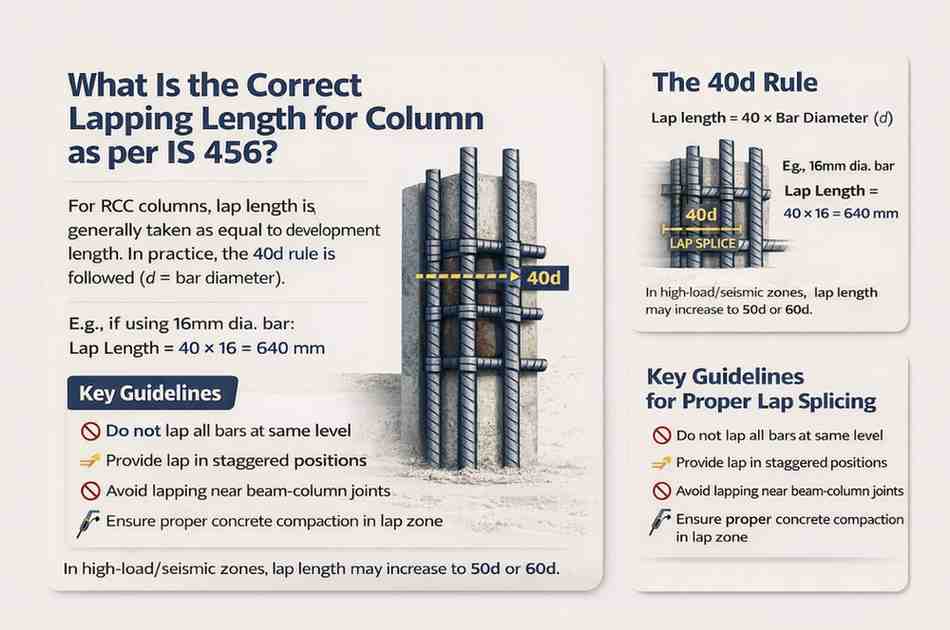
According to IS 456:2000, lap length in compression members (like columns) is generally equal to development length (Ld).
For compression:
Lap Length = Development Length
Usually taken as 40d to 60d
Where:
d = Diameter of bar
For most site practices:
-
Minimum lap length = 24d
-
Common practice = 40d
-
For higher safety = 50d or 60d
Calculation Example of Lap Length
Let’s calculate for different bar diameters.
Formula:
Lap Length = 40 × Diameter
| Bar Diameter | Lap Length (40d) | Lap Length (50d) |
| 12 mm | 480 mm | 600 mm |
| 16 mm | 640 mm | 800 mm |
| 20 mm | 800 mm | 1000 mm |
| 25 mm | 1000 mm | 1250 mm |
| 32 mm | 1280 mm | 1600 mm |
So if a column has 16mm bars:
Lap Length = 40 × 16 = 640 mm
Difference Between Tension and Compression Lap
Columns mainly work in compression. That is why lap requirements are slightly lower compared to tension members like beams.
-
In compression: 40d is usually sufficient
-
In tension: 50d to 60d required
That’s why the lap length for the column differs from the beam.
Where Should the Lap Be Provided in the Column?
This is very important from practical site experience.
Rules:
-
Do not provide lap at the beam-column junction.
-
Do not lap all bars at the same height.
-
Provide a staggered lap.
-
Keep the lap away from the maximum stress zone.
-
Ensure proper binding wire tying.
Proper Position of Lap in Column
In good construction practice:
-
The lap should be provided in the middle portion of the column height
-
Maximum 50% bars should be lapped at one level
-
Remaining bars should be lapped at different heights
Important Site Guidelines for Lapping Length for Column
1. Minimum Clear Cover- Ensure proper concrete cover (usually 40mm for columns).
2. Proper Compaction- Honeycombing in the lap region can reduce bond strength.
3. Avoid Congestion – Too many bars lapped at the same level cause concrete placement issues.
4. Use of Couplers (Modern Alternative) – In high-rise buildings, mechanical couplers are used instead of traditional lap to reduce steel congestion.
The old-school lap method is reliable and economical, but modern couplers provide better structural efficiency in tall structures.
Common Mistakes in Column Lapping
Let’s talk real site problems.
❌ All bars lapped at the same level
❌ Insufficient lap length
❌ Lap provided near column base
❌ Poor binding
❌ No staggering
Practical Thumb Rules Used on Site
Even though the IS code gives a detailed formula, many engineers use these practical approximations:
-
For 12mm bar → 500 mm lap
-
For 16mm bar → 650 mm lap
-
For 20mm bar → 800 mm lap
-
For 25mm bar → 1000 mm lap
These values generally follow the 40d rule.
In Conclusion
Lapping length for column is necessary to ensure proper load transfer and structural continuity in construction. Generally calculated as 40 times the bar diameter, it must be provided carefully with a staggered Pattern and correct positioning.
Following IS 456 guidelines and proper site rules provides long-term structural safety. Whether using traditional lap method or modern couplers, understanding the correct lapping length is critical for every civil engineer and site supervisor.
Also read- TMT Bar Weight Chart (8mm, 10mm, 12mm & 038; 16mm)